Late payment follow-up is the part of freelancing nobody warns you about. The work is done. The invoice is sent. The due date came and went. Now you are staring at WhatsApp wondering how to ask a client for ₹40,000 without sounding desperate. This guide gives you four copy-paste scripts that work for Indian freelancers. One for the day you send the invoice, one for the day after due date, one for a week overdue, and one for two weeks. Plus the rules that decide which channel (WhatsApp or email) and what tone to use at each stage.
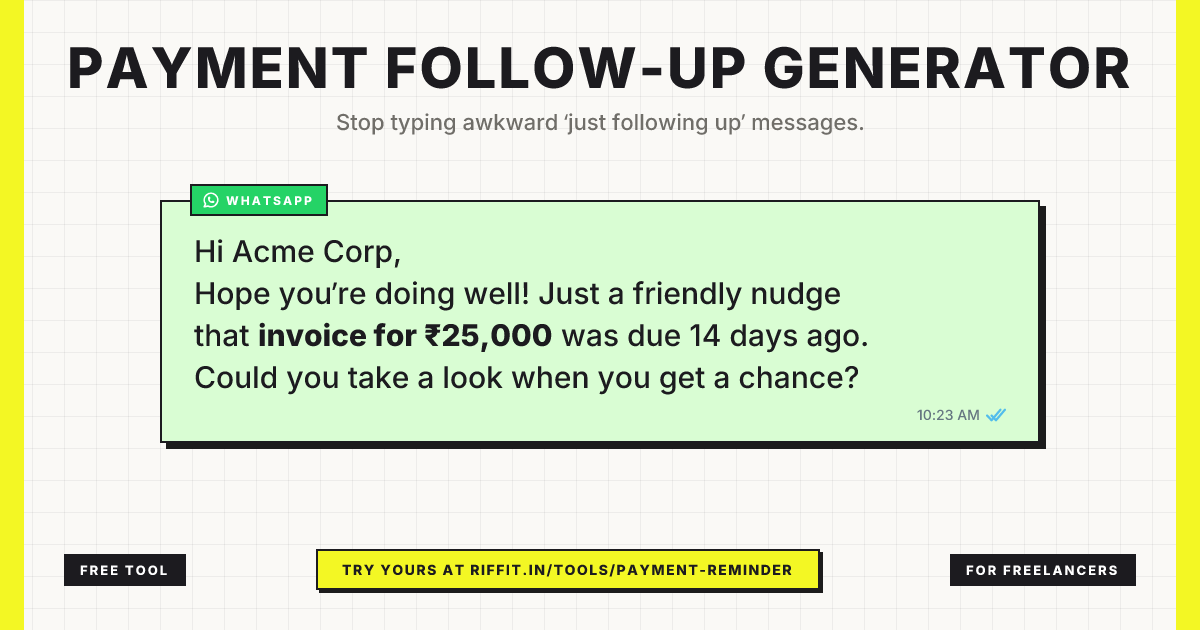
Payment Follow-Up Generator
Generate professional payment reminder messages for WhatsApp in 10 seconds. From gentle nudge to nuclear option.
Try it →Set the terms before the invoice goes out
Most late payment problems start before the payment is even due. The freelancer sends an invoice without clear payment terms, and the client defaults to paying whenever they feel like it.
Before you invoice, make sure the client knows:
When payment is due. "Net 15" means 15 days from the invoice date, but don't assume the client knows that; write the actual due date on the invoice instead. "Due by: April 2, 2026" is clearer than "Net 15." If you're still figuring out what terms to set, choosing the right payment terms before you send the first invoice makes every follow-up easier.
How to pay. Include your UPI ID, bank details, or a payment link directly on the invoice. The fewer steps between "I should pay this" and "I've paid this," the faster it happens.
What happens if it's late. You don't need to charge late fees (most Indian freelancers don't), but mentioning a gentle policy upfront changes the dynamic. Something like "Invoices unpaid after 15 days may delay the start of future work" gives you a real lever to pull without being aggressive. If you want that policy in writing from day one, this freelance contract template has a payment-terms and late-fee clause you can lift.
If you're working on a project worth ₹50,000 or more, consider milestone billing: 50% upfront, 50% on delivery. This reduces your exposure and gives the client less reason to delay.
For a full breakdown of payment terms and invoice formatting, see our guide to creating freelance invoices in India.
The 4-touch system
When a payment is overdue, don't wing it. Use a structured system so every follow-up is intentional, escalating in tone but never hostile. Here's the system:
If you want the WhatsApp wording for every stage, including the heads-up three days before the due date that stops most of this happening, the WhatsApp payment reminder scripts for every stage has the exact messages.
Touch 1: Day the invoice is sent (confirmation)
This isn't a reminder, it's a confirmation that the invoice exists. Most freelancers skip this step, which means the first time they mention the invoice is when it's already overdue. Bad starting position.
WhatsApp message:
Hey [Client Name] 👋 Just sent over the invoice for [project/deliverable]: INV26-001, ₹40,000. Due by [date]. Let me know if everything looks good!
Why it works: It's not asking for payment. It's confirming delivery and putting the due date in the client's mind early. If there's a problem with the invoice (wrong amount, wrong details), you'll find out now instead of after it's overdue.
Touch 2: 1 day after the due date (gentle nudge)
The payment was due yesterday, and the client probably just forgot. Most late payments aren't malicious. People are busy, and this message assumes good faith.
WhatsApp message:
Hi [Client Name], quick heads-up: the invoice for [project] (₹40,000) was due yesterday. Just wanted to make sure it didn't slip through. Let me know if you need me to resend anything!
Email version:
Subject: Invoice INV26-001, just checking in
Hi [Client Name],
Wanted to flag that invoice INV26-001 for ₹40,000 was due on [date]. No rush on a response, just wanted to make sure it's on your radar. Happy to resend the invoice or payment details if needed.
Thanks, [Your Name]
Why it works: No pressure, no guilt, just a factual nudge. The phrase "didn't slip through" gives the client an easy out, so they can say "oh, I missed it" without losing face.
Touch 3: 5–7 days overdue (direct follow-up)
It's been a week, so this is no longer a "maybe they forgot" situation. This message is polite but clear: you expect payment.
WhatsApp message:
Hey [Client Name], following up on invoice INV26-001 for ₹40,000. It's been about a week past the due date. Could you let me know when I can expect the payment? Happy to sort out any issues on my end.
Email version:
Subject: Payment overdue: Invoice INV26-001
Hi [Client Name],
Following up on invoice INV26-001 for ₹40,000, which was due on [date]. It's now [X] days overdue.
I'd appreciate an update on when the payment will be processed. If there's an issue with the invoice or payment details, I'm happy to help sort it out.
Thanks, [Your Name]
Why it works: The subject line says "overdue," and that's intentional. The tone is still professional, but the message is unambiguous. You're not checking in anymore, you're asking for a date.
 On Pro, Riffit automates this kind of sequence: polite reminders before, on and after the due date, by email and WhatsApp, without you drafting a single one. Free sends one on the due date. You handle touch 4 only if it ever gets that far.★ Rated 4.5/5 by early users on CapterraTry Riffit free
Touch 4: 14+ days overdue (the boundary)
Two weeks overdue. At this point, you need to set a clear boundary. This message is firm but not angry. The goal is to get a commitment: either a payment date or an explanation.
WhatsApp message:
Hi [Client Name], the invoice for [project] has been overdue for two weeks now. I'd really appreciate getting this sorted. Could you confirm a payment date? I'll need to pause any upcoming work until the outstanding balance is cleared.
Email version:
Subject: Outstanding payment: action needed
Hi [Client Name],
Invoice INV26-001 for ₹40,000 has been outstanding for [X] days. I've followed up a couple of times and haven't received an update.
I'd like to resolve this directly. Could you confirm a specific date for payment? Please note that I'll need to pause any new work on [upcoming project/retainer] until the outstanding amount is cleared.
I value our working relationship and want to get this resolved.
Thanks, [Your Name]
Why it works: "Pause any upcoming work" is the strongest lever a freelancer has. Not a threat, a reasonable business boundary. You're not withholding completed work, you're saying "I can't start new work when existing invoices are unpaid." That's fair.
Riffit sends payment reminders automatically on Pro, so you never type these messages yourself.Try Riffit freeRules for following up
A system only works if you follow it consistently. Keep these rules in mind:
Always follow up in the same channel the client uses. If they talk to you on WhatsApp, remind them on WhatsApp. If they're email-only, use email. Don't switch channels to "escalate." It feels passive-aggressive.
Never apologise for following up. "Sorry to bother you, but..." undermines your position. You did work and you sent an invoice. Following up is professional, not rude.
Include the invoice number and amount every time. Don't make the client dig through old messages to find what you're talking about. Every follow-up should have enough context to act on immediately.
Keep it short. The longer your message, the easier it is to ignore. Three to four sentences is the sweet spot for WhatsApp. Emails can be slightly longer but shouldn't exceed one scroll.
Don't follow up on weekends or late at night. It reads as desperate. Weekday mornings between 10 AM and 12 PM are ideal, since the client is at their desk, in work mode, and more likely to action it.
Track everything. If you're managing multiple clients and invoices, you need to know which ones are overdue and by how many days. This is where a dashboard matters. You shouldn't be scrolling through WhatsApp chats to piece together your payment status.
What not to do
Don't threaten legal action unless you mean it. Mentioning "legal action" in a WhatsApp message to a client who's 10 days late is disproportionate and will end the relationship immediately. Save it for genuinely non-responsive, high-value situations, and talk to a lawyer first.
Don't get emotional. "I have bills to pay too" or "this is really unfair" might be true, but it shifts the dynamic from professional to personal. Keep it factual.
Don't CC their boss or team. If your point of contact hasn't paid, escalating to their manager via CC feels like a betrayal. Ask the client directly if there's someone else you should coordinate with for payments.
Don't stop working mid-project as revenge. Withholding completed deliverables or ghosting mid-project hurts you more than them. The boundary is about new work, not existing commitments.
Prevention is better than follow-up
The best payment follow-up is the one you never have to send. A few things that reduce late payments before they happen:
Bill on approval, not on completion. The moment a client says "looks good" or "approved," that's when the invoice goes out. Not tomorrow. Not after the weekend. Right then. Client satisfaction is highest at the moment of approval. Capture it.
If you're not sure what should go on your invoice, our guide to invoicing mistakes covers the five most common errors that cause payment delays.
Use milestone billing for anything over ₹50,000. Split the project into 2-3 milestones, each with its own invoice. This way, you're never more than one milestone behind on payment, and the client has a clear connection between work delivered and money owed.
Make paying easy. Include a UPI payment link or QR code on every invoice. If the client has to ask for your bank details or figure out how to pay, you've added friction. Friction causes delay.
Send invoices during business hours. An invoice sent at 11 PM on a Friday will sit in someone's inbox until Monday at the earliest. Send it Tuesday or Wednesday morning. It sounds trivial, but timing affects how quickly people act.
When polite reminders stop working
If 14 days overdue turns into 30, and 30 turns into 60, the four-touch system above stops being enough. Before any of the routes below, there is one written step most freelancers skip: a formal payment request letter with a single deadline. Indian freelancers have real escalation routes, most of them rarely talked about. None of what follows is legal advice. Talk to a lawyer for your specific situation. But here's what's worth knowing before you need it.
MSME ODR portal (it replaced Samadhaan for new cases)
If you are registered on the Udyam Registration Portal as a micro or small enterprise, the MSMED Act 2006 puts real weight behind you. A buyer has to pay you by the date agreed in writing, and that date cannot be more than 45 days after they accept your work. If nothing was agreed in writing, the limit is 15 days from acceptance. Work counts as accepted unless the buyer objects in writing within 15 days of delivery. Pay later than that, and the buyer owes compound interest at three times the bank rate notified by the RBI.
New delayed-payment complaints go to the MSME ODR portal, which now takes new cases in place of the older Samadhaan portal. On paper, the Micro and Small Enterprise Facilitation Council has 90 days to decide. In practice, expect months. Two catches: only micro and small enterprises qualify, and your Udyam registration has to come before the work. Registering later does not cover work you already delivered. Registration is free, takes about 10 minutes online, and is worth doing before you ever need it.
Section 138 of the Negotiable Instruments Act
If your client paid with a cheque that bounced, you have a strong criminal-civil hybrid case. Send a written legal notice within 30 days of the bank's dishonour memo; the client has 15 days to pay before you can file a complaint. Conviction can mean up to two years' imprisonment or a fine up to twice the cheque amount. Most cases settle before trial.
Civil recovery suit
For amounts above ₹3 lakh, a civil money suit is the standard route. For smaller amounts, consumer courts or summary procedure under CPC Order 37 can be faster. Talk to a lawyer about which fits your situation. Fees and timelines vary by state.
Lawyer's legal notice
A formal legal notice from a lawyer often unblocks payment without further steps. There is no fixed fee: it varies by city and lawyer, and the figures freelancers mention in public forums run from about ₹1,500 to ₹10,000 or more, so ask upfront and weigh it against what you are owed. Many clients pay the day a notice arrives. The optics of being sued outweigh the cost of paying. It's usually the cheapest, fastest escalation step before any of the routes above.
FAQ
Whichever step finally works, send something when the money arrives. Taking a moment to confirm the payment ends a long chase cleanly, and the restraint matters more here than in any other message you send.
Send a gentle nudge 1 day after the due date. If the client has a history of paying on time, one extra day of grace is fine. But never wait more than 2-3 days for the first follow-up. The longer you wait, the lower the priority your invoice becomes in their mind.
You can, but most Indian freelancers don't. It can strain client relationships, especially with repeat clients. A better approach is to include a clause like 'Invoices unpaid after 15 days may delay the start of future work.' This creates urgency without a financial penalty.
Ask for a specific date. 'When can I expect the payment?' is better than accepting a vague 'soon.' If the amount is large, offer to split it into two payments with clear dates. Get the agreement in writing. A WhatsApp message confirming the dates is enough.
Use whatever channel the client normally communicates on. In India, that is usually WhatsApp. The first 1-2 follow-ups work well on WhatsApp. For anything beyond 7 days overdue, sending an email creates a more formal paper trail.
Only if you are registered on the Udyam Registration Portal as a micro or small enterprise, and the registration came before the work was supplied. New complaints go to the MSME ODR portal, which took over new cases from the older Samadhaan portal. On paper the Micro and Small Enterprise Facilitation Council has 90 days to decide; in practice, expect months. Without Udyam registration, you still have the civil-suit and Section 138 options, but not this route.
If a small invoice (under ₹10,000) is still unpaid after 90 days and the client has stopped responding, the cost of recovery may exceed the amount itself. Document the loss with your accountant (it is a deductible business expense) and decline future work from that client. For larger amounts, escalation is almost always worth the effort: even a lawyer's notice costs less than most unpaid invoices.
Yes, and what you get depends on the plan. Free accounts get one reminder, on the due date, by email. The Pro plan adds the full schedule: before the due date, on the day, and after it, sent on WhatsApp as well as email. You set the schedule, Riffit sends the follow-up so you never have to type an awkward reminder message again.